> For the complete documentation index, see [llms.txt](https://developers.make.com/llms.txt). Markdown versions of documentation pages are available by appending `.md` to page URLs; this page is available as [Markdown](https://developers.make.com/custom-apps-documentation/app-components/modules/universal-module.md).
# Universal
A universal module can be used to perform an arbitrary API call to the service's API. It allows the user to specify all parameters of the request while using the app's connection.
Every app using API should have a universal module. An app can have only one universal module.
{% hint style="warning" %}
**Security notice**
As the universal module allows the user to specify the target URL, it's **highly important** that the universal module has to use a **relative path**. Otherwise, a user could point the request to their own custom servers and get access to the access tokens.
**A universal module that doesn't match this condition won't be approved by Make to be used in scenarios.**
{% endhint %}
There are two types of universal modules. Choose one depending on the API you use:
* [REST API](/custom-apps-documentation/app-components/modules/universal-module/rest.md)
* [GraphQL API](/custom-apps-documentation/app-components/modules/universal-module/graphql.md)
## Components
Components of the universal module are the same as for the [action module](/custom-apps-documentation/app-components/modules/action.md#components)**.**
## Available IML variables
You can use all of the IML variables available for [action modules](/custom-apps-documentation/app-components/modules/action/components.md#available-iml-variables) in the universal module, except for the `iterate` directive.
## Universal module in a scenario
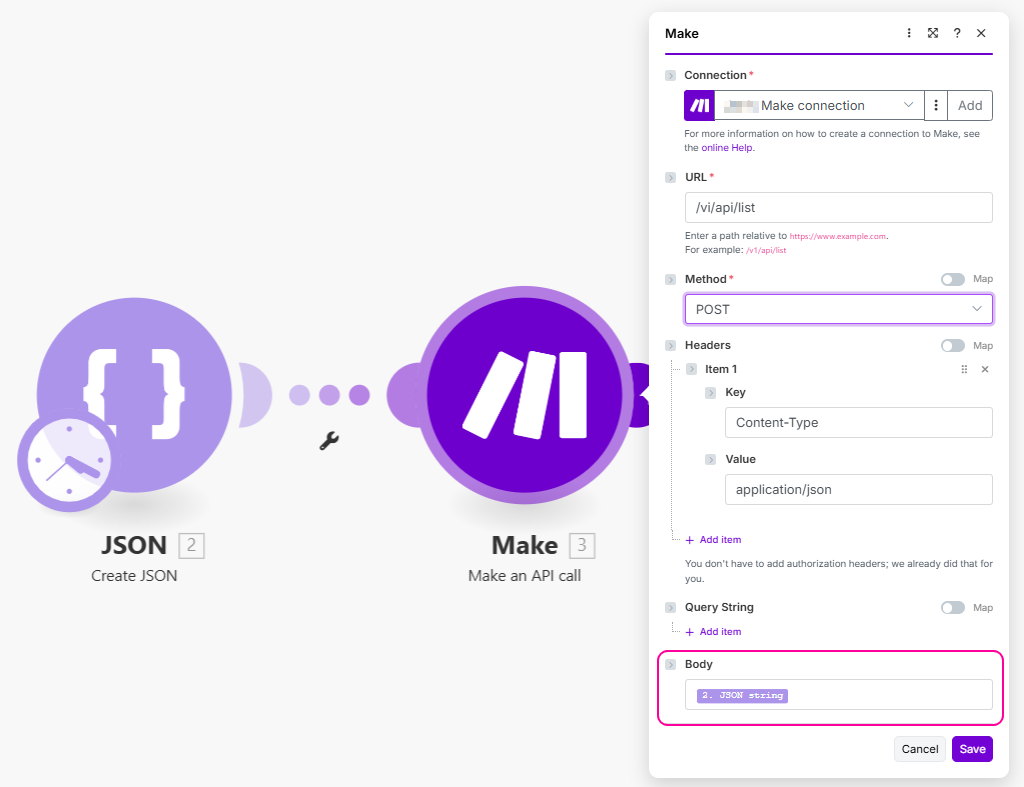
When a universal module is used in a scenario, it is recommended to use it together with a **JSON > Create JSON** module. Not only it is much easier to create the structure of JSON for the universal, but also all characters, which are part of JSON definition and should be considered as letters, are escaped.
---
# Agent Instructions
This documentation is published with GitBook. GitBook is the documentation platform designed so that both humans and AI agents can read, navigate, and reason over technical content effectively. Learn more at gitbook.com.
## Querying This Documentation
If you need additional information that is not directly available in this page, you can query the documentation dynamically by asking a question.
Perform an HTTP GET request on the current page URL with the `ask` query parameter, and the optional `goal` query parameter:
```
GET https://developers.make.com/custom-apps-documentation/app-components/modules/universal-module.md?ask=&goal=
```
`ask` is the immediate question: it should be specific, self-contained, and written in natural language.
`goal` is optional and describes the broader end goal you are ultimately trying to accomplish on behalf of the user. GitBook uses it to tailor the answer towards what is most useful for that goal.
The response will contain a direct answer to the question and relevant excerpts and sources from the documentation.
Use this mechanism when the answer is not explicitly present in the current page, you need clarification or additional context, or you want to retrieve related documentation sections.