> For the complete documentation index, see [llms.txt](https://developers.make.com/llms.txt). Markdown versions of documentation pages are available by appending `.md` to page URLs; this page is available as [Markdown](https://developers.make.com/custom-apps-documentation/create-your-first-app/test-your-app.md).
# Test your app
To test your app in Make, create a new scenario.
{% stepper %}
{% step %}
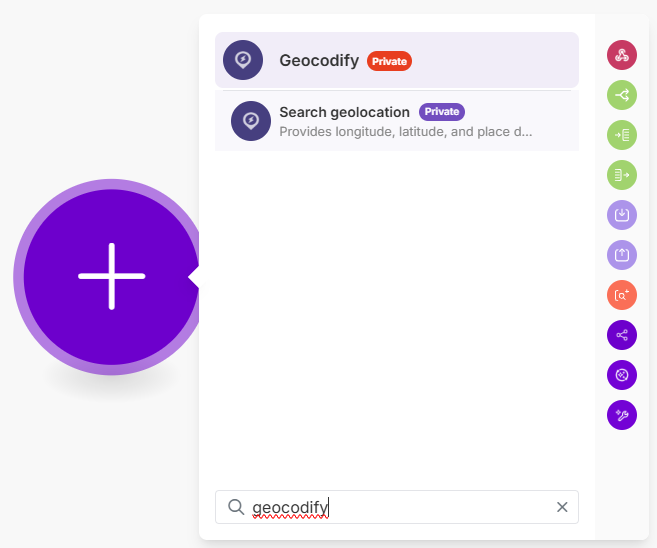
In the Scenario Builder, add the **Geocodify > Search geolocation** module that you have just created.
Note that is has the **Private** tag.
{% endstep %}
{% step %}
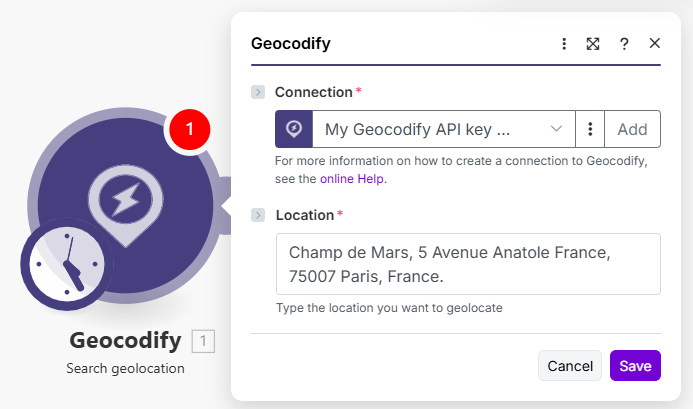
Click **Create a connection**.
{% endstep %}
{% step %}
Enter your API Key from the Geocodify API.
{% endstep %}
{% step %}
Click **Save**.
{% endstep %}
{% step %}
Insert the address you want to geolocate, for example: Champ de Mars, 5 Avenue Anatole France, 75007 Paris, France.
This is the Location parameter you set up in the Mappable parameters tab.
{% endstep %}
{% step %}
Click **Save** to save the module.
{% endstep %}
{% step %}
Save the scenario. A pop-up appears appears asking for confirmation to install the app in your organization.
* Click **Yes** on the pop-up to install the app in your organization.
* Click **Run once** to run the scenario.
{% endstep %}
{% step %}
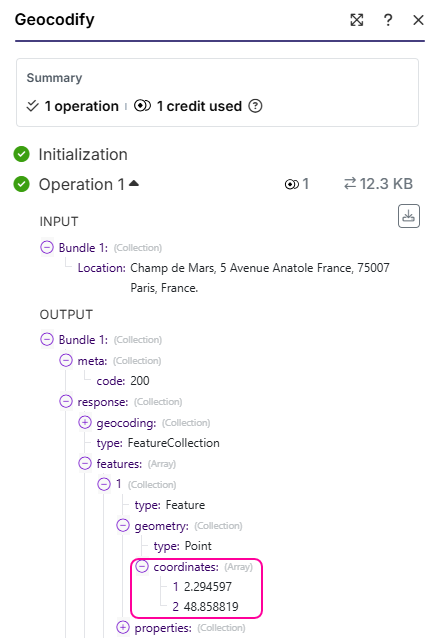
Open the output to retrieve the coordinates. They are under **Output> Bundle 1>** **response> features> 1> geometry> coordinates**.
The coordinates are output this way because you chose to return the response as is, without filtering or customization.
{% endstep %}
{% endstepper %}
Your app works. Congratulations!
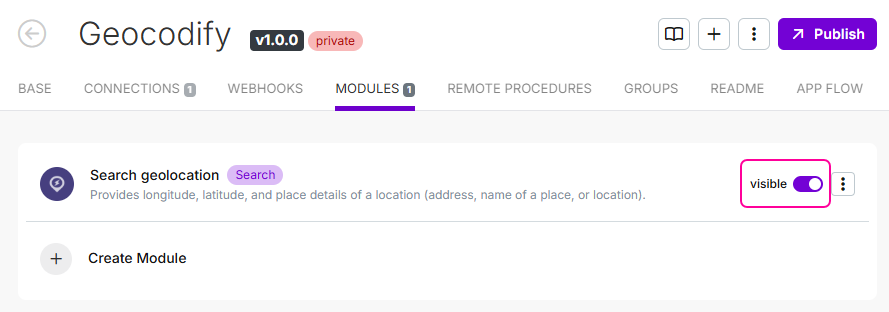
At this point, your module is hidden by default. Even if the app is installed in the organization, it won't appear in the scenario editor for other users until you make it visible.
To let other users see your module, go to the module in the app setup and slide the toggle from hidden to visible.
To learn more about app and module visibility, see the [App visibility article](/custom-apps-documentation/create-your-first-app/app-visibility.md).
---
# Agent Instructions
This documentation is published with GitBook. GitBook is the documentation platform designed so that both humans and AI agents can read, navigate, and reason over technical content effectively. Learn more at gitbook.com.
## Querying This Documentation
If you need additional information that is not directly available in this page, you can query the documentation dynamically by asking a question.
Perform an HTTP GET request on the current page URL with the `ask` query parameter, and the optional `goal` query parameter:
```
GET https://developers.make.com/custom-apps-documentation/create-your-first-app/test-your-app.md?ask=&goal=
```
`ask` is the immediate question: it should be specific, self-contained, and written in natural language.
`goal` is optional and describes the broader end goal you are ultimately trying to accomplish on behalf of the user. GitBook uses it to tailor the answer towards what is most useful for that goal.
The response will contain a direct answer to the question and relevant excerpts and sources from the documentation.
Use this mechanism when the answer is not explicitly present in the current page, you need clarification or additional context, or you want to retrieve related documentation sections.