> For the complete documentation index, see [llms.txt](https://developers.make.com/llms.txt). Markdown versions of documentation pages are available by appending `.md` to page URLs; this page is available as [Markdown](https://developers.make.com/custom-apps-documentation/debug-your-app/debugging-of-custom-iml-functions.md).
# Custom IML functions
Debug custom IML functions with a variety of tools
To debug your IML functions, output the code and use a tool of your choosing.
## Output a message to the dev console
You can use `debug` inside your IML functions to print a message or mid-results of your code.\
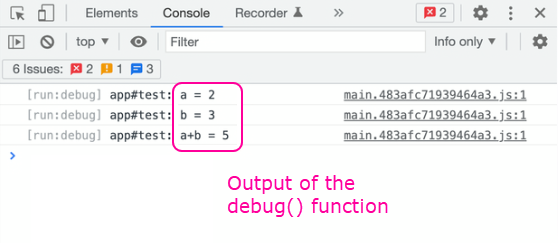
During the function execution, debug messages are visible inside the console of your browser.
{% hint style="info" %}
To open the developer console in Google Chrome, open the Chrome Menu in the upper-right-hand corner of the browser window and select **More Tools > Developer Tools**. You can also use **Option + ⌘ + J** (on macOS), or **Shift + CTRL + J** (on Windows/Linux).
{% endhint %}
{% tabs %}
{% tab title="IML function" %}
```javascript
function add(a, b) {
let sum = a + b;
//instead of usual console.log(), use debug().
debug("a = " + a)
debug('b = ' + b)
debug(`a+b = ${sum}`)
return sum;
}
```
{% hint style="info" %}
By using `debug()` you can understand what data you are manipulating inside a function.
{% endhint %}
{% endtab %}
{% tab title="Console messages" %}
{% hint style="info" %}
During the run of a module, IML functions called inside this module will also run.
All debug messages that you specified in the IML function are available inside the developer console of your browser.
{% endhint %}
{% endtab %}
{% endtabs %}
## Debug the JavaScript snippet
To debug the output, you can use a variety of tools. Search online to find a JavaScript debugging tool that you prefer.
Here are some to choose from:
* [JS Playground](https://www.jsplayground.dev/)
* [Mozilla developer playground](https://developer.mozilla.org/fr/play)
* [RunJS](https://runjs.app/)
{% tabs %}
{% tab title="Sample code to test" %}
```javascript
function myFunction(x) {
x = x + 1;
//do something
console.log(x); // outputs the value of x at this point
return x;
}
myFunction(1);
```
{% hint style="info" %}
You can use this code to test the functionality of the JavaScript debugger to see how it works.
{% endhint %}
{% endtab %}
{% endtabs %}
---
# Agent Instructions
This documentation is published with GitBook. GitBook is the documentation platform designed so that both humans and AI agents can read, navigate, and reason over technical content effectively. Learn more at gitbook.com.
## Querying This Documentation
If you need additional information that is not directly available in this page, you can query the documentation dynamically by asking a question.
Perform an HTTP GET request on the current page URL with the `ask` query parameter, and the optional `goal` query parameter:
```
GET https://developers.make.com/custom-apps-documentation/debug-your-app/debugging-of-custom-iml-functions.md?ask=&goal=
```
`ask` is the immediate question: it should be specific, self-contained, and written in natural language.
`goal` is optional and describes the broader end goal you are ultimately trying to accomplish on behalf of the user. GitBook uses it to tailor the answer towards what is most useful for that goal.
The response will contain a direct answer to the question and relevant excerpts and sources from the documentation.
Use this mechanism when the answer is not explicitly present in the current page, you need clarification or additional context, or you want to retrieve related documentation sections.